




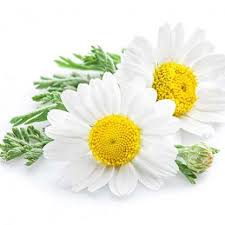
Chamomile Essential Oil Profile
Chamomile Essential Oil
Matricaria recutita / Chamaemelum nobile
Botanical Family: Asteraceae (Compositae)
Species
The common name "chamomile" is used to describe at least four different essential oils, one of which comes from a different genus entirely. The confusion stems partly from the blue color some oils share, and partly from historically tangled botanical nomenclature.
German Chamomile (Matricaria recutita / M. chamomilla)
Also called Hungarian chamomile or blue chamomile. "Matricaria" means "mother herb." This oil is a deep blue color with a tart, intense aroma. It has excellent anti-inflammatory and antispasmodic properties.
Roman Chamomile (Chamaemelum nobile / Anthemis nobilis)
A pale blue, almost colorless oil with a sweet, fruity-herbaceous aroma. Roman chamomile is the preferred choice for insomnia, headaches, and nervous conditions. Shop our Certified Organic Roman Chamomile Essential Oil.
Moroccan Chamomile (Ormenis multicaulis)
Also known as Chamaemelum mixtum (Jeanne Rose, 1994). Often sold as chamomile, it is less expensive than Roman or German. The oil is pale yellow to yellow-brown with a fresh, herbaceous aroma and fruity, spicy undertones. Ormenis oil is anti-infectious and tonic for the nervous system, and is commonly used for skin conditions including sensitive skin, eczema, and dermatitis.
Moroccan Blue Chamomile (Tanacetum annuum)
Despite its name and inky blue color resembling German chamomile, this is NOT a true chamomile and is not a substitute. It has a sweeter, fruitier aroma.
Description
German chamomile is an annual herb growing to about two feet tall, with a hairless, branching stem. Roman chamomile is shorter and stockier with a many-branched, hairy stem. Both have feathery leaves and daisy-like flowers; Roman chamomile has larger blooms. Moroccan chamomile (Ormenis) does not resemble the other two: it grows 3 to 4 feet tall with hairy leaves and tubular yellow flowers.
Distribution
German chamomile is native to Europe and Asia and naturalized in North America and Australia. No longer cultivated in Germany, it is now grown primarily in Hungary and Eastern Europe. Roman chamomile is native to southwestern Europe and naturalized in North America; it is cultivated in England, Hungary, Italy, Belgium, and France, with oil often distilled in England. Chamomiles frequently grow as weeds along roadsides and in open fields. German chamomile prefers sun and dry, sandy soil; the double-flowering form of Roman chamomile requires richer, moister soil. Moroccan chamomile (Ormenis) is native to Africa and Spain, possibly evolved from a widespread Ormenis species throughout the Mediterranean. The oil is distilled in Morocco.
Extraction
Essential oil is steam distilled from the flowering heads of German, Roman, and Moroccan chamomile.
Traditional Uses
Chamomile has a long history of medicinal use across many cultures. The Egyptians used it as a fever-reducing agent. The Greeks called it "ground apple" for its apple-like aroma. The Saxons called it "maythen" and considered it one of nine sacred herbs given to the world by their god, Woden. During the Middle Ages it was used as a strewing herb. German chamomile's name "matricaria" reflects its traditional role as a gynecological herb. Distilled from fresh flowers since medieval times, the essential oil was valued for its anti-inflammatory action on the skin and for treatment of digestive and bronchial disorders. Chamomile is also sedative and was traditionally thought to dispel melancholy.

%0A%0ASpecies%0AThe%20common%20name%20%22chamomile%22%20is%20used%20to%20describe%20at%20least%20four%20different%20essential%20...)